Microsoft Access Linked Sql Server Read Uncommitted?
One of the most mutual problems that occur while running concurrent transactions is the Dirty Read problem. A dirty read occurs when one transaction is permitted to read data that is being modified past some other transaction that is running concurrently but which has non even so committed itself.
If the transaction that modifies the information commits itself, the dirty read trouble doesn't occur. However if the transaction that modifies the data is rolled dorsum after the other transaction has read the data, the latter transaction has muddy data that doesn't actually exist.
As always, be sure you are well backed upward earlier experimenting with a new code. See this article on backing upwardly MS SQL databases if you're not sure.
Let's sympathize this with the assist of an example. Suppose we have a tabular array named 'Product' that stores id, proper noun, and ItemsinStock for the product.
The tabular array looks similar this:
[tabular array id=20 /]
Suppose you lot have an online organisation where a user can buy products and view products at the aforementioned time. Take a expect at the post-obit figure.
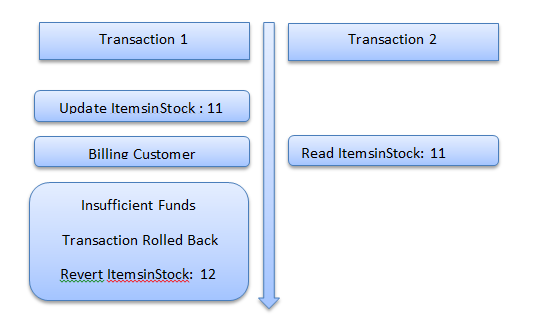
Consider a scenario where a user tries to buy a production. Transaction one will perform the purchase task for the user. The first step in the transaction will be to update the ItemsinStock.
Earlier the transaction, there are 12 items in the stock; the transaction will update this to 11. The transaction will now communicate with an external billing gateway.
If at this signal in time, another transaction, let's say Transaction 2, reads ItemsInStock for laptops, it will read eleven. Even so, if subsequently, the user behind Transaction ane turns out to accept insufficient funds in his account, Transaction 1 will exist rolled dorsum and the value for ItemsInStock column volition revert to 12.
However, Transaction 2 has eleven as the value for ItemsInStock column. This is muddied data and the trouble is called dirty read problem.
Working Example of Dingy Read Problem
Let's us take a wait at the muddy read problem in action in SQL Server. As ever, outset, let's create our tabular array and add some dummy information to it. Execute the following script on your database server.
CREATE DATABASE pos; USE pos; CREATE Table products ( Id INT Master Fundamental, Proper name VARCHAR(l) NOT NULL, ItemsinStock INT Not NULL ) INSERT into products VALUES (1, 'Laptop', 12), (2, 'iPhone', 15), (3, 'Tablets', ten) Now, open 2 SQL server direction studio instances next. Nosotros will run one transaction in each of these instances.
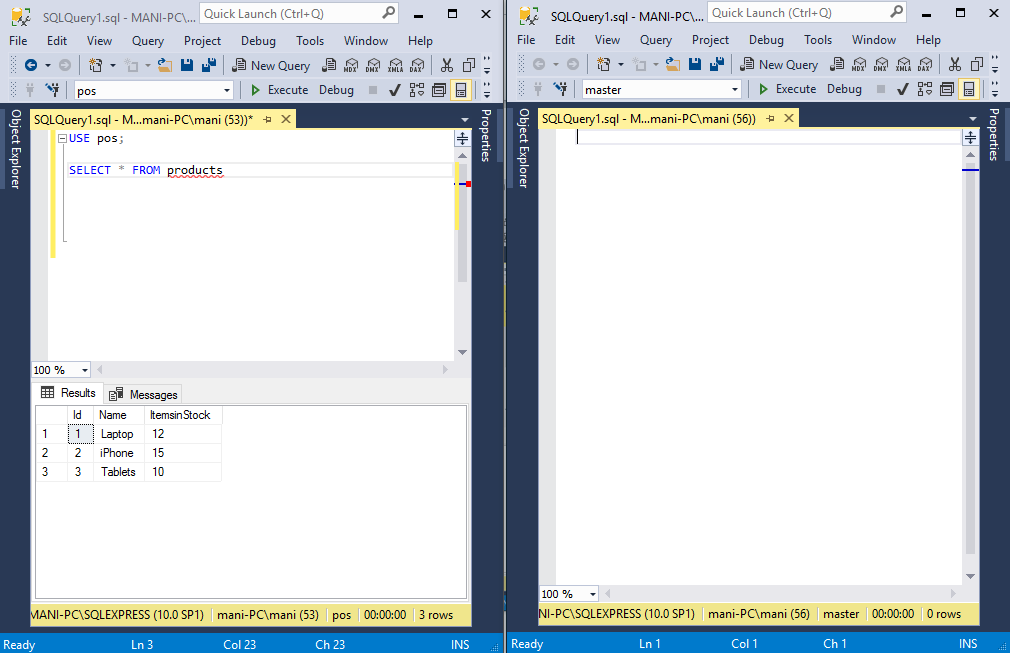
Add together the following script to the first instance of SSMS.
Utilize pos; SELECT * FROM products -- Transaction one Begin Tran UPDATE products set ItemsInStock = 11 WHERE Id = 1 -- Billing the customer WaitFor Delay '00:00:ten' Rollback Transaction In the above script, we start a new transaction that updates the value for the "ItemsInStock" column of the products tabular array where Id is 1. We so simulate the delay for billing the customer past using the 'WaitFor' and 'Delay' functions. A delay of 10 seconds has been set in the script. Subsequently that, nosotros simply gyre back the transaction.
In the second instance of SSMS, we simply add following SELECT statement.
Use pos; -- Transaction ii SELECT * FROM products WHERE Id = 1 Now, first run the showtime transaction, i.east. execute the script in the first instance of SSMS, and then immediately execute the script in the 2d instance of the SSMS.
You will see that both transactions volition keep executing for ten seconds and after that, yous volition see that the value for the 'ItemsInStock' column for the tape with Id 1 is still 12 as shown by the second transaction. Though the beginning transaction updated it to 11, waited for 10 seconds, and then rolled it back to 12, the value shown by the second transaction is 12 rather than 11.
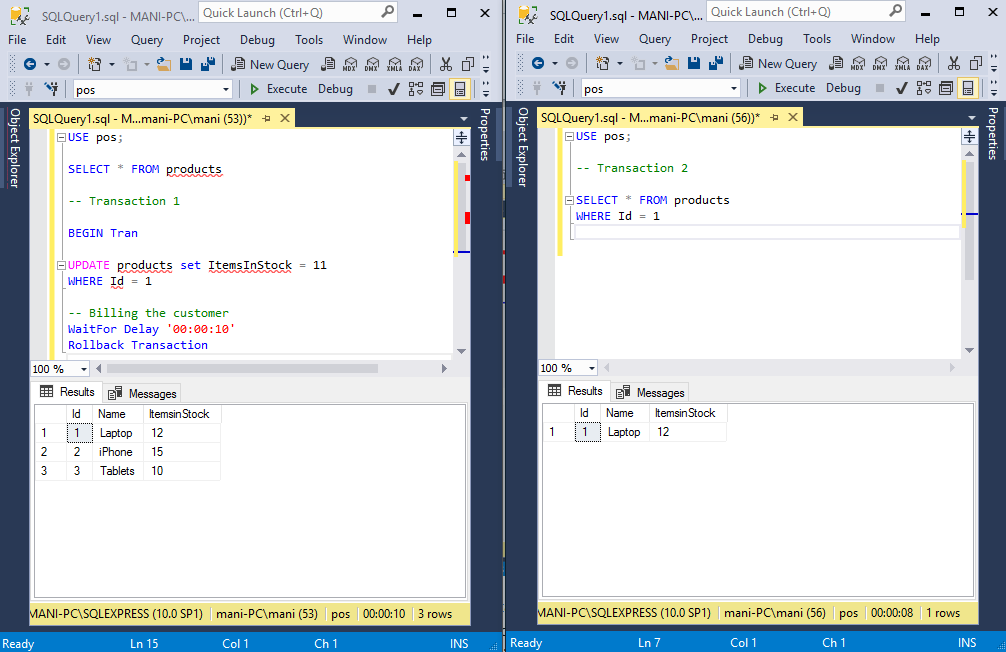
What actually happened is that when nosotros ran the first transaction, it updated the value for the 'ItemsinStock' column. It then waited for 10 seconds so rolled the transaction back.
Though we started the second transaction immediately subsequently the start, information technology had to expect for the first transaction to complete. That is why the 2nd transaction also waited for 10 seconds and why the second transaction executed immediately after the first transaction completed its execution.
Read Committed Isolation Level
Why did transaction 2 accept to wait for the completion of transaction 1 before it executed?
The respond is that the default isolation level between transactions is "read committed". The Read Committed isolation level ensures that data tin can only be read by a transaction if it is in the committed state.
In our example, transaction i updated the data but information technology did non commit it until it was rolled back. This is why transaction two had to wait for transaction 1 to commit the data or rollback the transaction before it could read the data.
Now, in practical scenarios, nosotros frequently accept multiple transactions taking place on a single database at the aforementioned time and we do not desire every transaction to have to expect for its turn. This can make databases very slow. Imagine buying something online from a big website which could only process one transaction at a time!
Reading Uncommitted Information
The reply to this problem is to allow your transactions to work with uncommitted information.
To read uncommitted data, but prepare the isolation level of the transaction to "read uncommitted." Update the transaction 2 past adding an isolation level as per the script below.
Employ pos; -- Transaction 2 set transaction isolation level read uncommitted SELECT * FROM products WHERE Id = one Now if you run the transaction 1 and then immediately run transaction 2, you will see that transaction 2 volition non expect for transaction 1 to commit data. Transaction 2 will immediately read the dirty data. This is shown in the post-obit figure:
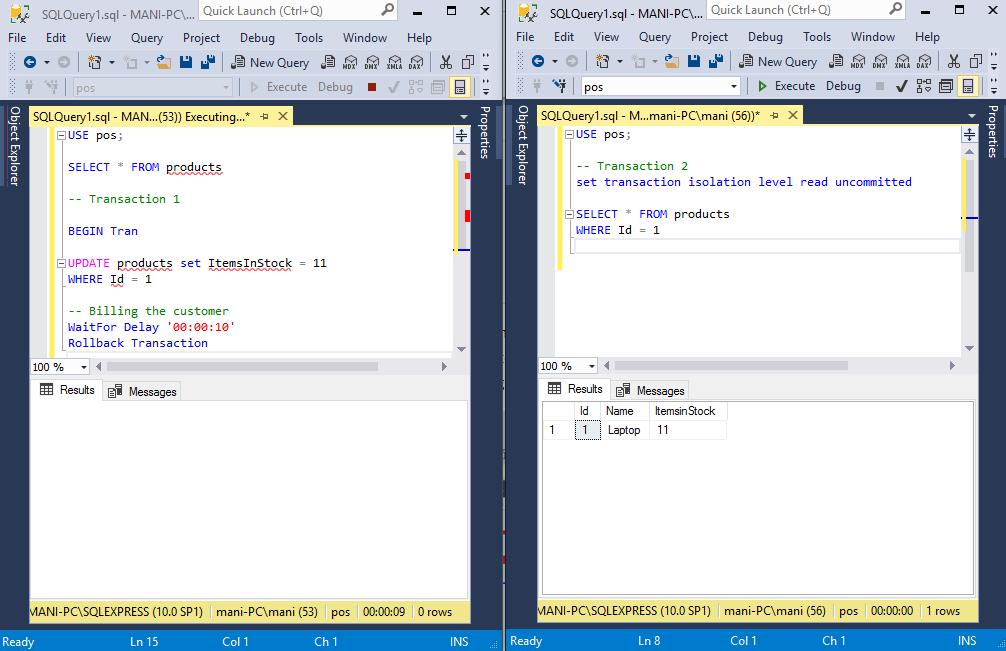
Here the instance on the left is running transaction ane and the instance on the right is running transaction 2.
We run transaction 1 start which updates the value of "ItemsinStock" for id ane to 11 from 12 so waits for x seconds before being rolled dorsum.
Meanwhile, transaction due west reads the dirty data which is eleven, as shown in the upshot window on the right. Because transaction i is rolled back this is not the actual value in the tabular array. The actual value is 12. Effort executing transaction two again and yous will run across that this time it retrieves 12.
Read uncommitted is the only isolation level that has the dirty read problem. This isolation level is least restrictive of all the isolation levels and allows reading uncommitted data.
Plainly, at that place are pros and cons to using Read Uncommitted it depends on what application your database is used for. Obviously, it would exist a very bad thought to employ this for the database behind an ATM systems and other very secure systems. However, for applications where speed is very important (running large e-commerce stores) using Read Uncommitted makes more sense.
(Visited 38,644 times, 8 visits today)
Tags: sql server Last modified: September 23, 2021
Source: https://codingsight.com/understanding-dirty-read-problem-sql-server/
0 Response to "Microsoft Access Linked Sql Server Read Uncommitted?"
Postar um comentário