How Does the Rothko Chapel Create an Association With Religious Art of the Renaissance?
The Fine art Of
Churches
Art / Architecture / Design / Fashion
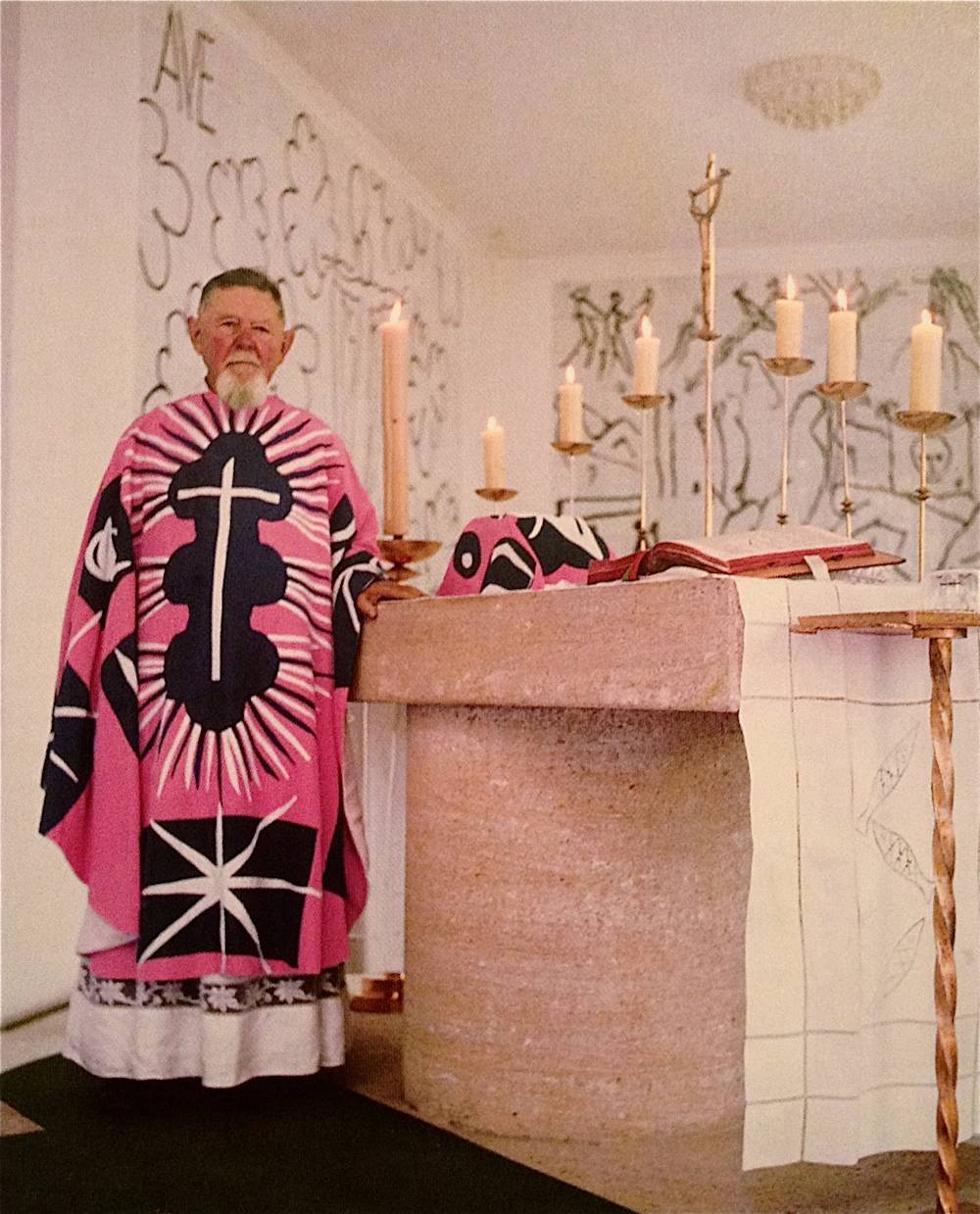
Henri Matisse
Chapel and Priest Vestments, 1949-1951
The emotions triggered when admiring a work of art are akin to a religious feel. For centuries, churches have served equally places of worship and structures of esteemed aesthetic beauty through their intrinsic connections to art and compages; particularly those throughout Western Europe.
From the Contarelli Chapel in Rome – its walls covered in 16th century baroque paintings by Caravaggio – to the renaissance frescos and remarkable Michelangelo-painted ceiling of the Sistine Chapel, artists take a longstanding history of utilizing church building interiors as their makeshift canvas. Regardless of religion or beliefs, churches are structures of pregnant architectural and artistic importance, each with their own nuances and beauty.
Claude Monet
Rouen Cathedral West Facade Sunlight, 1894
Claude Monet
Rouen Cathedral West Facade Sunlight, 1894
Vincent van Gogh
The Church building at Auvers, 1890
While the intimate human relationship shared betwixt artist and church building is most axiomatic in the innumerable structures scattered throughout Western Europe dating dorsum to the renaissance, the tradition continued to thrive for centuries to follow. The 1800s was a catamenia of 'church every bit subject', captured through the artistic eyes of impressionist and mail-impressionist painters – from Monet's prolific series of the Rouen Cathedral to Van Gogh's gloomy portrayal of The Church building at Auvers – while the 20th century was an era of installation. From unique structures, interiors, stained glass windows and mitt painted chasubles, artists redefined the role of creative collaborations in the context of Church design throughout the 20th century. Mark Rothko, Henri Matisse and Ellsworth Kelly are three primary examples of modern artists who take focused their creative energy towards designing churches.
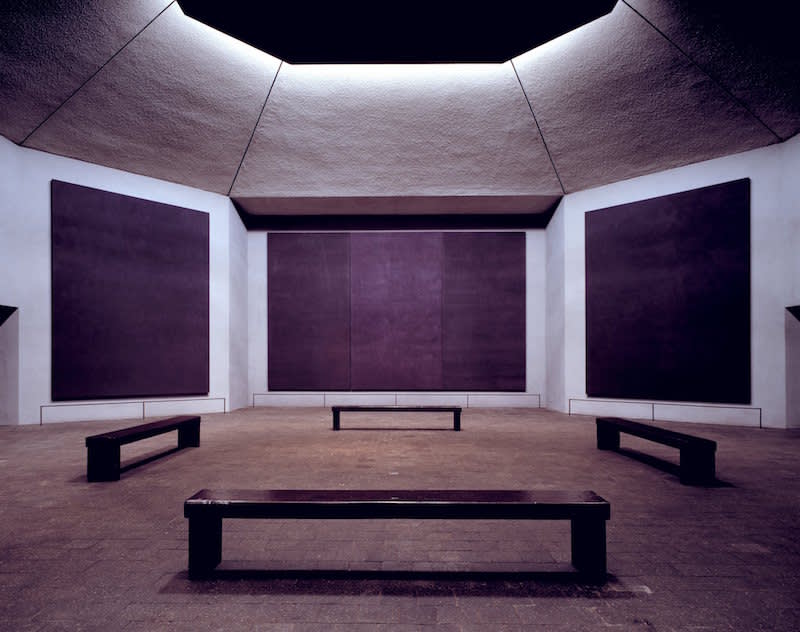
Mark Rothko
Chapel
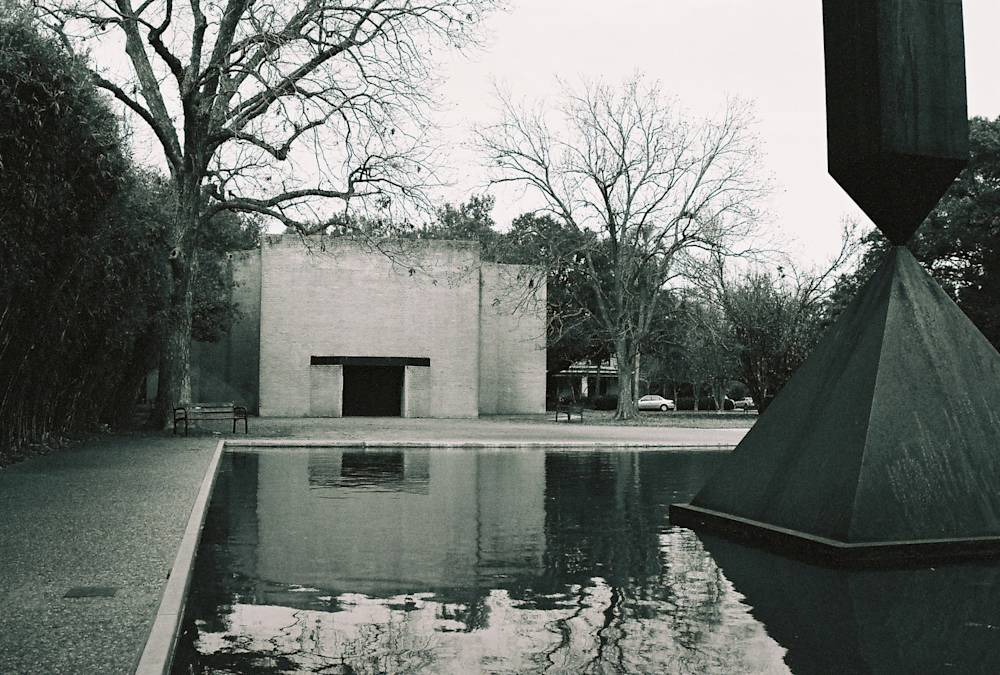
Mark Rothko
Chapel
In 1964, Mark Rothko was deputed past John and Dominique de Menil to create a not-denominational chapel in Houston, Texas. Rothko was given card blanche for the structure's design and interior. The artist hired a number of notable architects – including Philip Johnson – butting heads with each one, to realize his unique vision of creating a meditative environment filled with site-specific works of art. The resulting octagonal construction – its design heavily influenced by the Rothko – houses xiv large-calibration, site-specific black paintings, serving not simply as a chapel, only an immersive piece of work of modernistic art. Ultimately, after a lifelong struggle with depression, Rothko did not live to meet the chapel's completion in 1971.
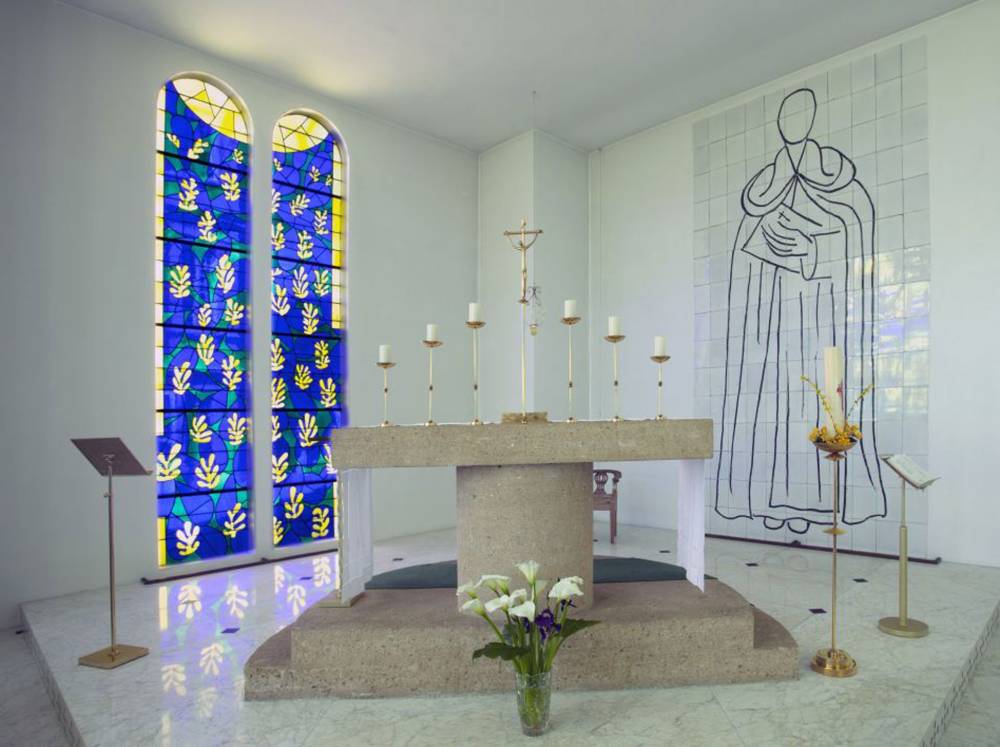
Henri Matisse
Chapel, 1949-1951
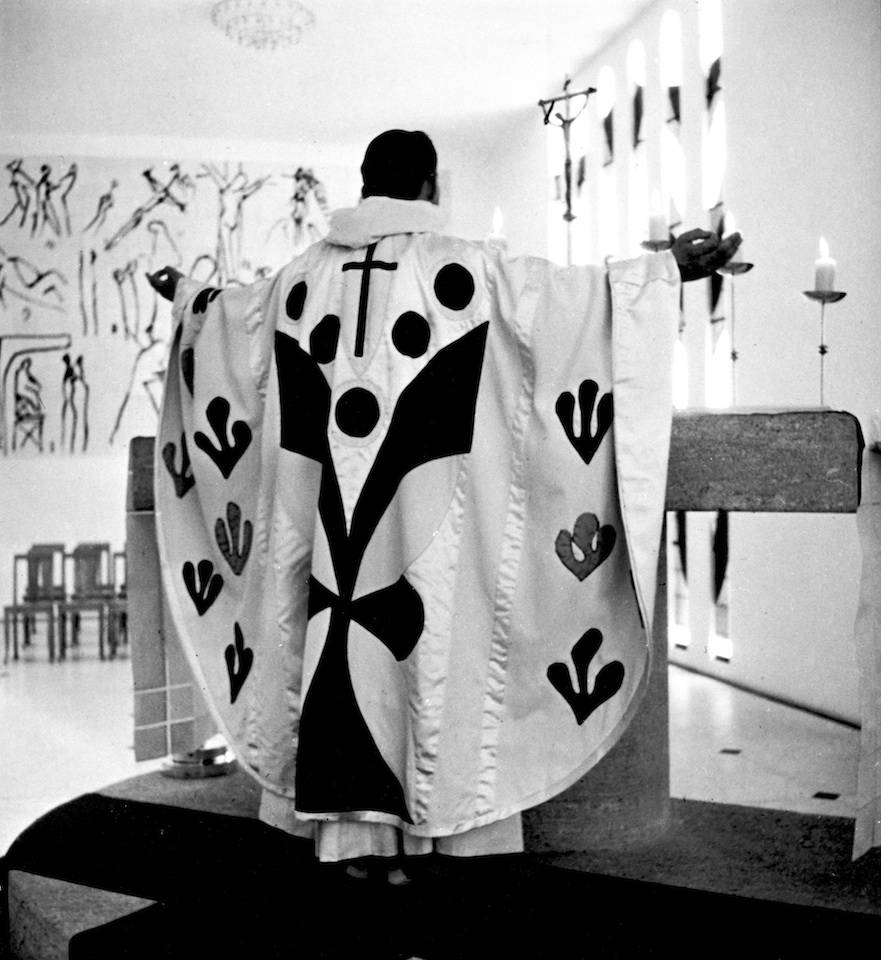
Henri Matisse
Chapel and Priest Vestments, 1949-1951
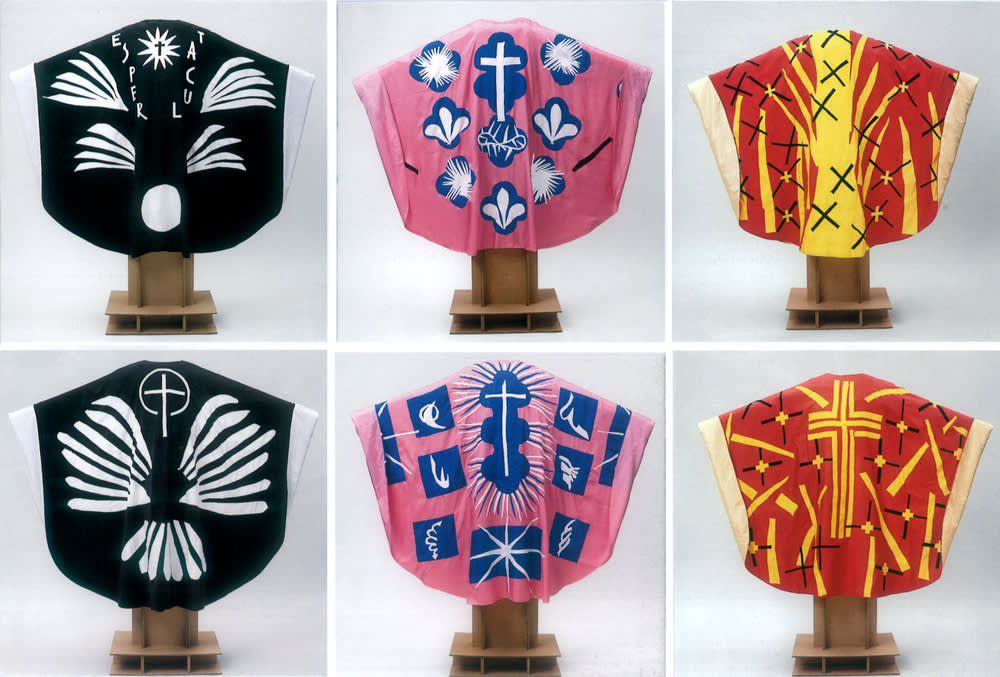
Henri Matisse
Chasubles, 1949-1951
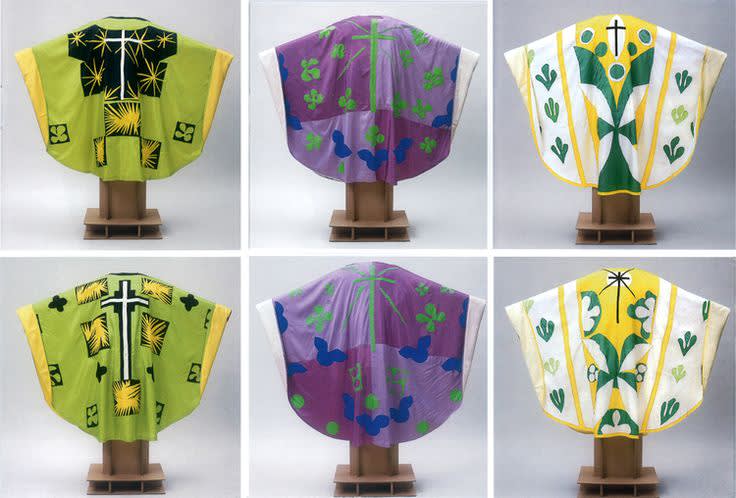
Henri Matisse
Chasubles, 1949-1951
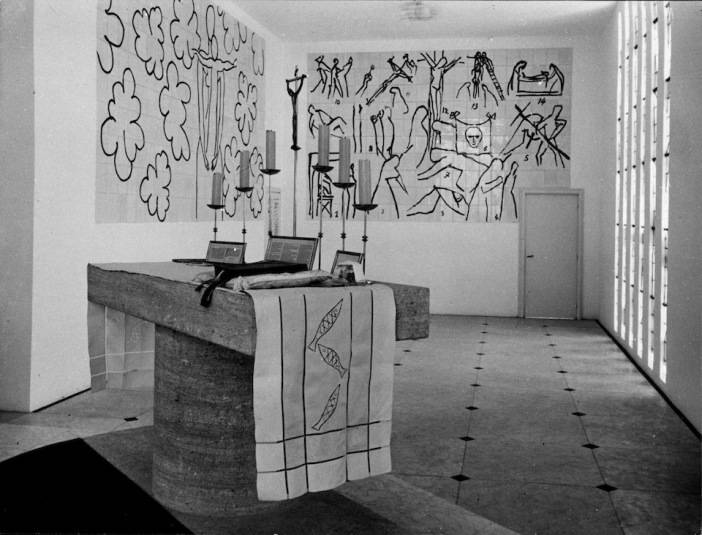
Henri Matisse
Chapel, 1949-1951
The Chapelle du Rosaire de Vence, often referred to every bit the Matisse Chapel, was designed and built between 1949 and 1951 under a scheme devised past Henri Matisse. The French artist began working on the project at the age of 77, spending more than four years devising plans for the chapel's architecture, stained glass windows, interior furnishings, murals and the priests' vestments. Prominent blueprint elements inside the chapel paid homage to Matisse's formal work every bit an artist, with stained glass windows mimicking shapes present in his cutouts, and fluid line drawings alike to his figurative works. The vibrant, Matisse-designed priest vestments employed traditional ecclesiastical colors of the religious seasons, including majestic, blackness, pink, green and red. Covered with unique patterns and Matisse iconography, the French painter offset drafted the ornamental elements with paper cutouts before manus-painting each blueprint.
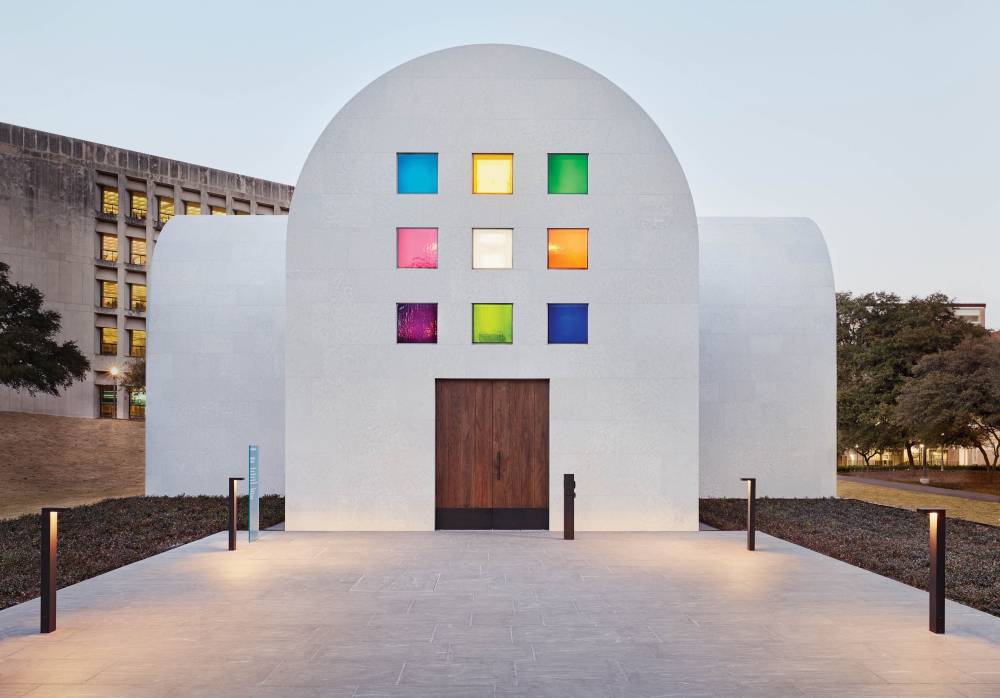
Ellsworth Kelly
Chapel
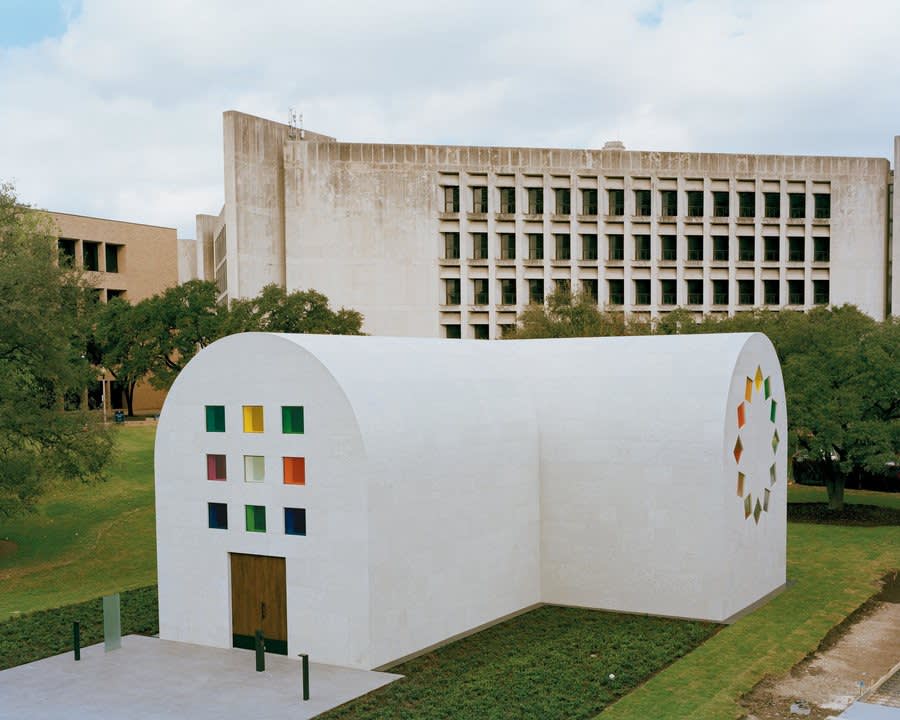
Ellsworth Kelly
Chapel
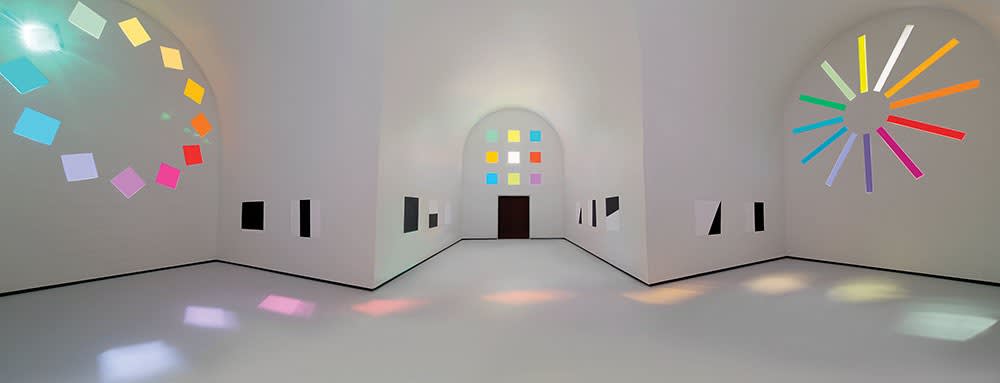
Ellsworth Kelly
Chapel Interior
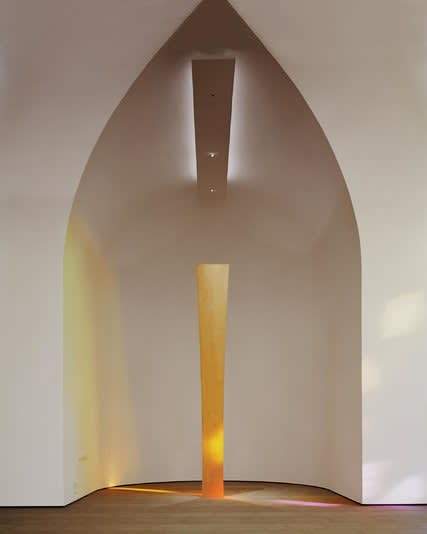
Ellsworth Kelly
Chapel Interior
Ellsworth Kelly
Chapel Interior
Ellsworth Kelly
Chapel Interior
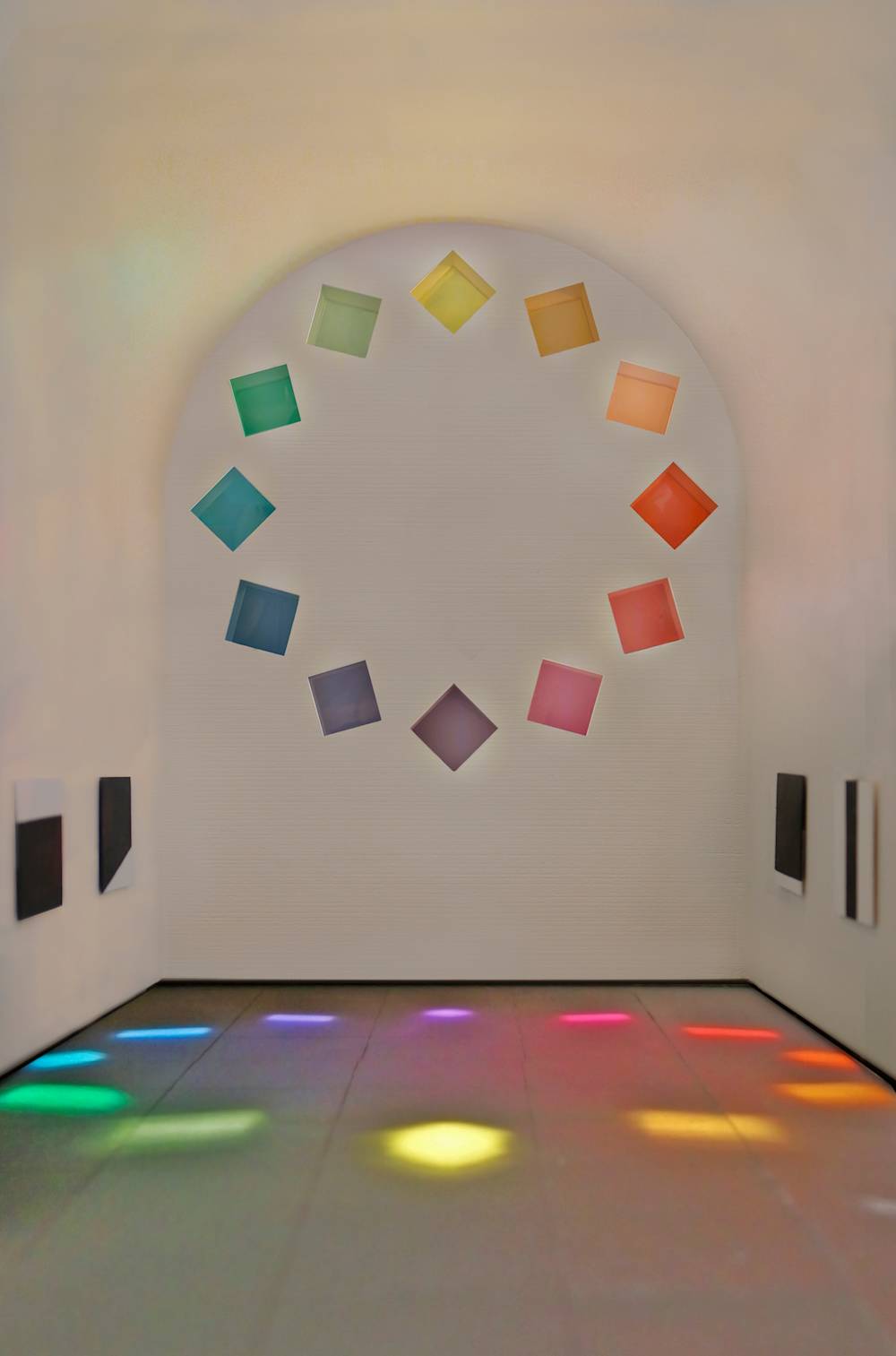
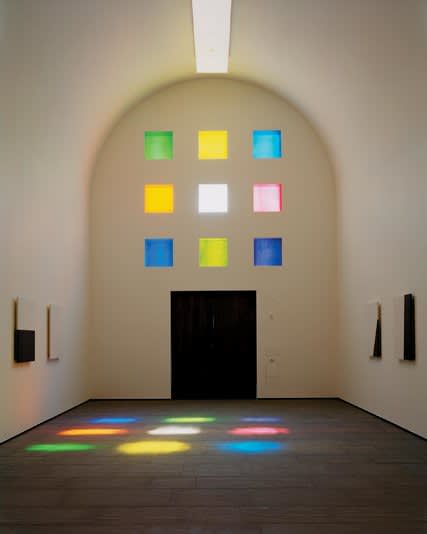
I of the most comprehensive examples of a painter utilizing a church building as an artistic medium is the vibrant sanctuary designed by Color Field artist Ellsworth Kelly. Recognized for his monochromatic, vibrant artful, Kelly's piece of work is grounded in the idea of stripping painting and sculpture down to elemental components of colour and form. In 1986, producer and collector Douglas Cramer approached Kelly to design an original, freestanding structure for his property in Santa Barbara, California. The resulting chapel, which eventually fell through, was put on concord for thirty years until 2015, when the structure was finally congenital on the campus of the Academy of Texas. The elementary, double-barrel-vaulted pattern – akin to Romanesque religious architecture – resembles an igloo in the shape of a cantankerous. Three of the building's four extended channels include unique, colorful stained drinking glass designs in geometric configurations; marker the artist's first endeavour at employing light to fully realize his artistic vision. Inside the stone chapel hang fourteen marble panels with varying black and white designs, and an eighteen-foot totem sculpture in place of a traditional cross. The static, achromatic artworks are in constant dialogue with the chapel's changing environment generated by colorful rays of light penetrating through the facade'due south stained glass windows.
Sigmar Polke Stained
Stained Glass Windows, 2009
Sigmar Polke
Stained Drinking glass Windows, 2009
Sigmar Polke Stained
Stained Glass Windows, 2009
Sigmar Polke
Stained Glass Windows, 2009
Gerhard Richter
Stained Glass Windows, 2007
Gerhard Richter
Stained Glass Windows (reflection), 2007
One of the most distinctive ornamental elements inside the design of nearly every church is the presence of stained drinking glass windows. While Ellsworth Kelly put detail emphasis on colorful windows within his tailor-made chapel, a number of contemporary artists accept created glass works for existing structures effectually the globe. In 2009, artist Sigmar Polke, who originally trained equally a glass painter, created a serial of twelve windows, with two singled-out design narratives, for the Grossmunster Church in Zurich. Vii of the church building'due south Romanesque windows exhibit abstract mosaics of thinly sliced, colorful agate, while the remaining 5 designs are figurative depictions of images from the Sometime Testament, based on medieval illuminations.
In Baronial 2007, German painter Gerhard Richter created a modern stained glass window for the due south transept of a catholic cathedral in Cologne, Germany; construction on this cathedral began in 1248 and was completed 632 years later in 1880. Richter'due south abstract work – surrounded by figurative, cosmic depictions – is composed of 11,500 identically sized pieces of colored glass, resembling pixels. The blueprint, alike to Richter's early colour charts, was generated and arranged randomly by a computer. The reflection of the piece of work imbues colorful light throughout the interior of the structure, creating an immense pixilated 'carpet' across the church'southward 19th century flooring.
Dan Flavin
Chiesa Rossa, 1996
Dan Flavin
Chiesa Rossa, 1996
Louise Conservative
Church, 1998
Louise Bourgeois
Church, 1998
Louise Conservative
Church building, 1998
Louise Conservative
Church building, 1998
In similar spirit to Polke and Richter'south temporary artistic exploration of painting with sunlight, artist Dan Flavin spent his career testing the limits and boundaries of color and light. In 1996, Flavin produced a site-specific work for Milan's Chiesa Rossa church building. The installation, made of green, blue, cerise and yellow neon lights, permeates the entirety of the space, mirroring the effect of traditional stained glass windows through artificial means. Unlike the evolving colorful reflections produced by natural light penetrating through glass, Flavin'due south installation is a highly controlled and intentional experience, mimicking the furnishings of night, dawn and mean solar day without relying on sunlight.
Similar Flavin, French artist Louise Bourgeois also employed an existing church as a setting to install her work. Since 1998, the Louise Bourgeois Church in Bonnieux, France, has housed a number of original sculptures by the French artist, each with varying religious undertones. Works include an erotic marble baptismal, a confessional with works in tapestry baring religious inscriptions, a sculpture of hands joined in prayer, a Christ in rags, and a statuary spider symbolizing a mother.
Le Corbusier
Notre Matriarch du Haut, 1955
Pierre Jeanneret
Ghandhi Bhawan, 1961
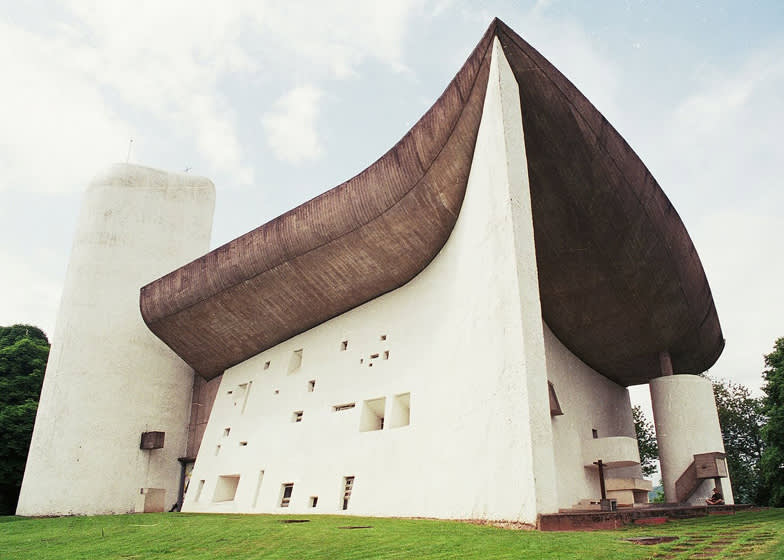
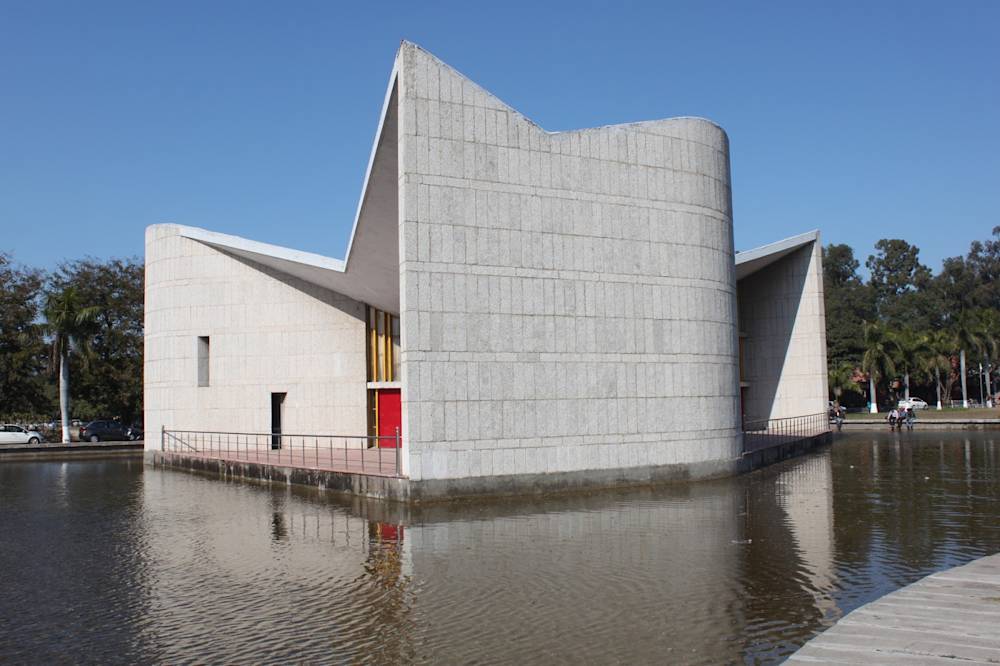
While churches have been captivating the creative minds of artists for centuries, they take proven equally inspiring environments for the work of modern architects. Throughout the mid 20th century, distinctive churches were erected around the globe, designed past the eras leading international architects. In 1950, Le Corbusier was commissioned to design a Roman Catholic chapel in Ronchamp, French republic. Notre Dame du Haut was completed in 1955, serving as 1 of the Franco-Swiss architect'due south about distinguished edifice likewise every bit a preeminent example of twentieth-century religious compages. Throughout the 1950s and 60s, Le Corbusier's cousin Pierre Jeanneret was living in Chandigarh, India, devoting his practice to a big civic architecture projection. In 1961, Jeanneret completed the Ghandhi Bhawan, a building designed to promote the study of Gandhian ideals; a less traditional example of a church building-similar structure, but a space erected for the sole purpose of forwarding the religious teachings of Gandhism.
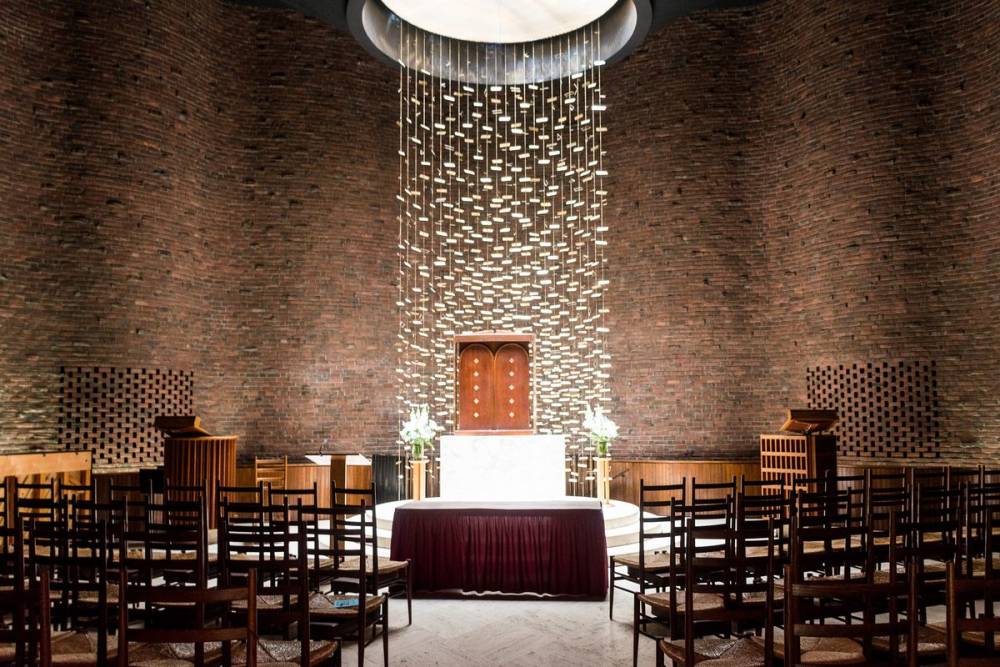
Eero Saarinen
MIT Chapel, 1955
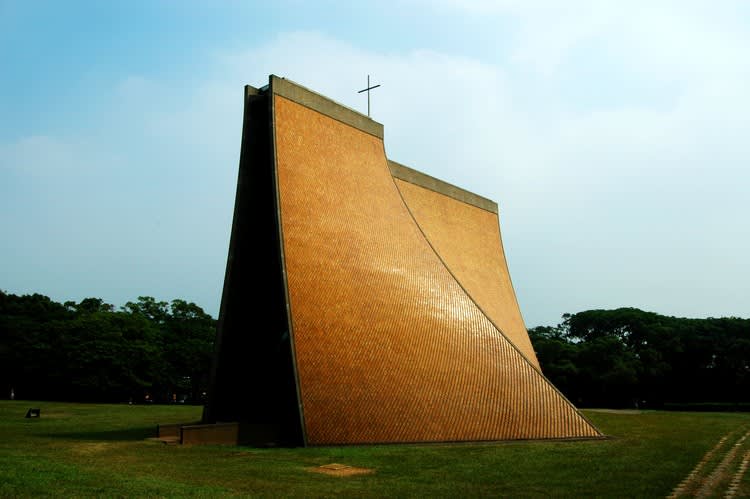
I.G. Pei
Luce Memorial Chapel, 1963
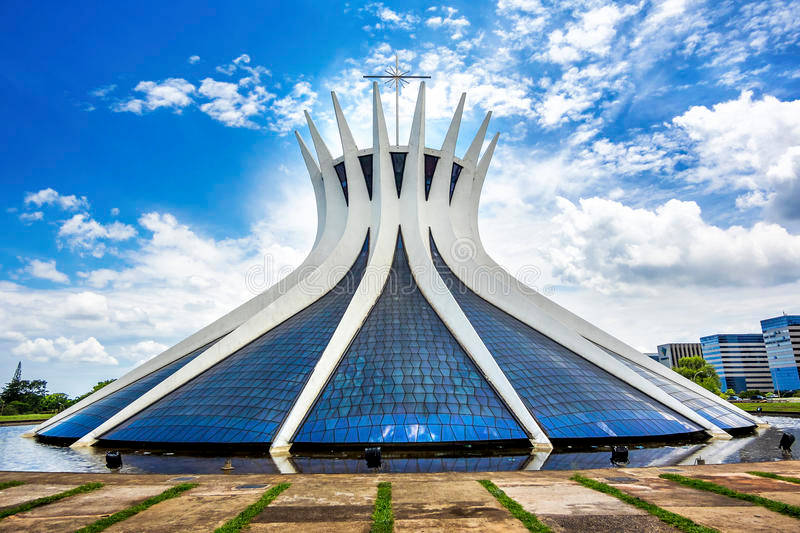
Oscar Niemeyer
Catedral de Brasilia, 1970
In 1955, Finnish architect Eero Saarinen designed a non-denominational chapel on the campus of MIT in Cambridge, Massachusetts; an intimate, cylindrical construction made of brick. Saarinen omitted windows from the building's pattern, except for a circular skylight, through which natural light filters down an atrium housing a metal sculpture by Harry Bertoia; a unproblematic oasis of mystic tranquility. In 1963, Chinese builder I.1000. Pei designed the Luce Memorial Chapel for the campus of Tunghai University in Taiwan as a sanctuary for the school's students and professors. The complex design made of reinforced concrete is covered in glazed diamond-shaped tiles, it's interior reflecting a similar geometric pattern, designed to house over 500 occupants. In 1970, Brazilian architect Oscar Niemeyer completed the Cathedral of Brasilia, a hyperboloid structure based on the geometry of 16 physical columns, serving both structural and esteemed ornamental ways.
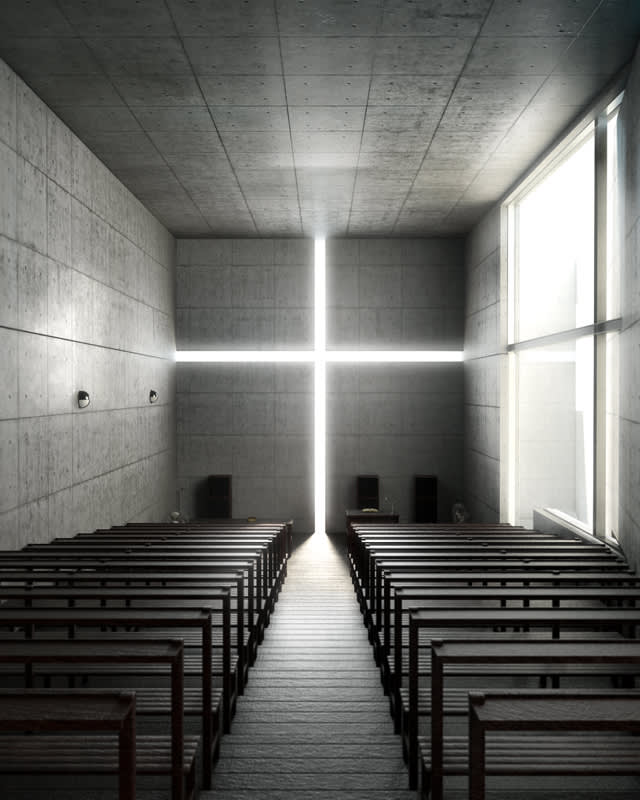
Tadao Ando
Church building of the Low-cal, 1989
In the tardily 1980s, Japanese architect Tadao Ando created the Church of the Light, in Osaka, Japan. The chapel'south modernist, reinforced concrete design – a trademark cloth of Ando's – employs a single wall of iv disjoined panels to filter light through the structure's interior in the shape of a cross. Instances of notable architects designing buildings of worship have connected into the 21st century, prominent examples including Richard Meier's Jubilee Church building outside central Rome and Peter Zumthor's Bruder Klaus Field Chapel in Germany, completed in 2003 and 2007, respectively. The inherent connection between compages, fine art and religion is palpable, grounded in each system's intrinsic tie to religion, worship, individualistic teaching philosophies and, in a higher place all, beauty.
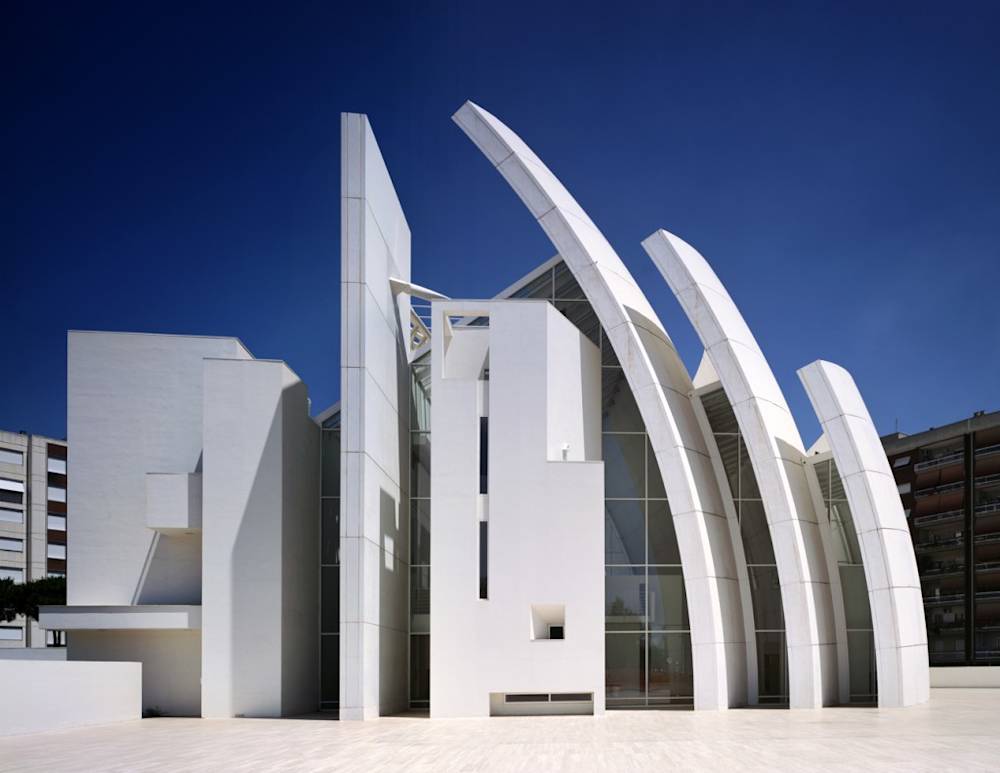
Richard Meier
Jubilee Church building, 2003
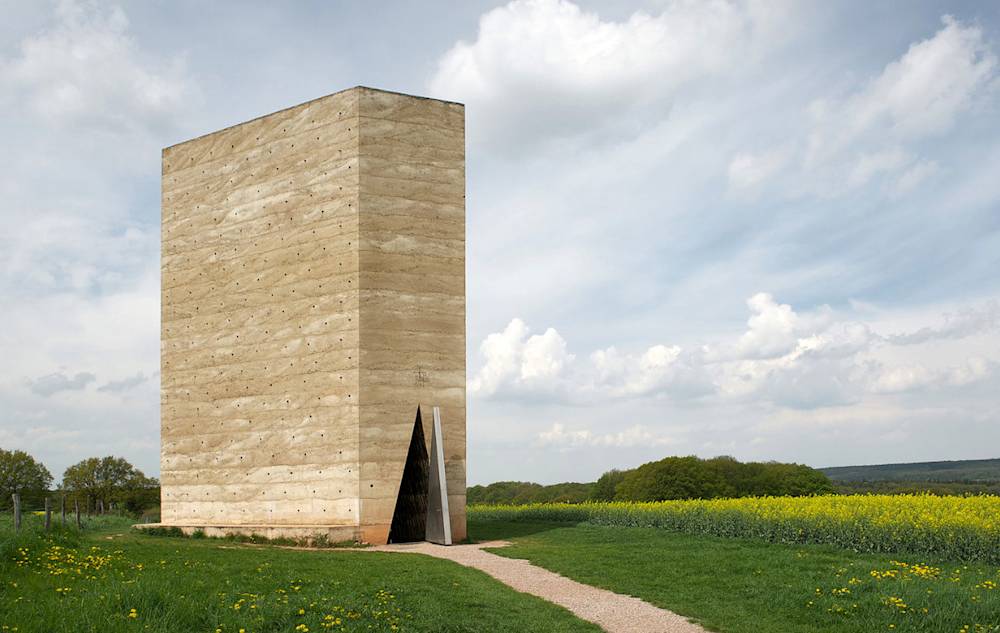
Peter Zumthor
Bruder Klaus Field Chapel, 2007
Additional Manufactures
Source: https://www.minniemuse.com/articles/art-of/churches
0 Response to "How Does the Rothko Chapel Create an Association With Religious Art of the Renaissance?"
Postar um comentário